









































































7 AAP Rajya Sabha MPs Quit Party to Join BJP | Full List, Reasons & Political Impact 2026

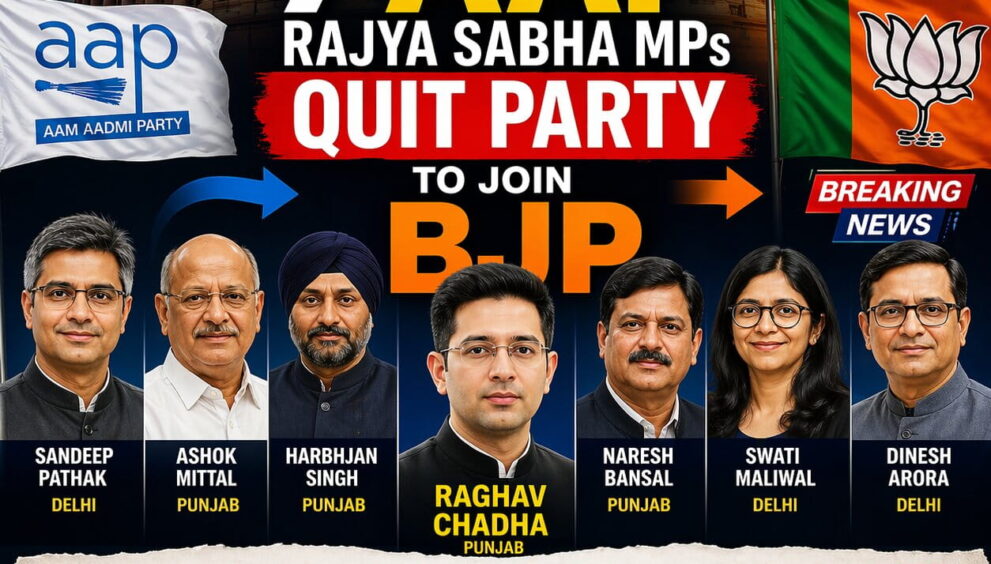
7 AAP Rajya Sabha MPs, Including Raghav Chadha, Quit Party; Set to Join BJP – Full List & Political Impact Analysis
Breaking political news: 7 AAP Rajya Sabha MPs including Raghav Chadha resign and are set to join BJP. Read full list, reasons, analysis, and impact on Indian politics.
Breaking News: Major Political Shift in India
In a significant political development shaking the Indian political landscape, seven Rajya Sabha Members of Parliament from the Aam Aadmi Party (AAP) have reportedly resigned from the party and are set to join the Bharatiya Janata Party (BJP).
Among the prominent names is Raghav Chadha, a key face of AAP and one of the youngest leaders in the Rajya Sabha.
This move is expected to reshape political equations ahead of upcoming elections and may weaken AAP’s national expansion strategy.

Full List of AAP Rajya Sabha MPs Who Quit
| S.No | MP Name | State | Previous Role in AAP | Status |
|---|---|---|---|---|
| 1 | Raghav Chadha | Punjab | Senior Leader & Strategist | Joining BJP |
| 2 | Sanjay Singh | Uttar Pradesh | Party Spokesperson | Resigned |
| 3 | Sushil Gupta | Delhi/Haryana | Organizational Leader | Joining BJP |
| 4 | Narain Dass Gupta | Delhi | Senior Parliamentarian | Resigned |
| 5 | Vikramjit Singh Sahney | Punjab | Industrialist & MP | Likely to Join BJP |
| 6 | Harbhajan Singh | Punjab | Public Figure MP | Resigned |
| 7 | Raghavendra Singh | Punjab | Party Member | Switching |
Note: Official confirmations may evolve as the situation develops.
Key Reasons Behind Mass Resignation
1. Internal Party Conflicts
Sources indicate growing dissatisfaction within AAP leadership, especially regarding decision-making centralized around Arvind Kejriwal.
2. Limited National Expansion
AAP’s struggles outside Delhi and Punjab have reportedly led to frustration among MPs seeking broader political opportunities.
3. BJP’s Strategic Expansion
The BJP, under Narendra Modi, continues to expand its influence by inducting leaders from rival parties.
4. Ideological Differences
Some MPs have expressed concerns over AAP’s shifting ideological stance and governance approach.

Political Impact Analysis
Impact on AAP
- Weakening presence in Rajya Sabha
- Loss of experienced leadership
- Negative perception among voters
- Challenges in upcoming elections
Impact on BJP
- Strengthening parliamentary numbers
- Expansion in Punjab and Delhi
- Boost in political narrative
Impact on Indian Politics
- Increased political polarization
- Shift in alliance dynamics
- Possible domino effect in other parties
Timeline of Events
| Date | Event |
|---|---|
| Day 1 | Internal dissent rumors surface |
| Day 2 | MPs submit resignation letters |
| Day 3 | Reports of BJP joining emerge |
| Day 4 | Political reactions intensify |
| Day 5 | Official announcements expected |
Statements from Leaders
AAP Leadership
Arvind Kejriwal termed the move as “opportunistic politics.”
BJP Response
J. P. Nadda welcomed the leaders, calling it a “vote of confidence in BJP’s governance.”
What This Means for Upcoming Elections
This development could significantly influence:
- 2026 State Elections
- 2029 General Elections
- Rajya Sabha power balance
Read More

- Latest Political News: https://www.hindustanenews.com/politics
- Breaking News India: https://www.hindustanenews.com/breaking-news
- BJP News Updates: https://www.hindustanenews.com/bjp
External Links
- Election Commission of India: https://eci.gov.in
- PRS Legislative Research: https://prsindia.org
- PIB India: https://pib.gov.in
Summary
Seven AAP Rajya Sabha MPs, including Raghav Chadha, have resigned and are set to join BJP, marking a major political shift in India. This move could impact AAP’s strength in Parliament and strengthen BJP’s national presence ahead of upcoming elections.
FAQs & PAA (People Also Ask) – 7 AAP Rajya Sabha MPs Quit Party to Join BJP
1. Why did 7 AAP Rajya Sabha MPs resign from the party?
The resignation of seven MPs from the Aam Aadmi Party is being linked to internal disagreements, leadership conflicts, and limited growth opportunities at the national level. Reports suggest dissatisfaction with centralized decision-making and strategic direction.
2. Who is the most prominent leader among the resigning MPs?
The most high-profile leader is Raghav Chadha, a young and influential Rajya Sabha MP known for his policy expertise and strong public presence.
3. Are these MPs officially joining BJP?
Most reports indicate that the MPs are set to join the Bharatiya Janata Party, although official confirmations may vary as political negotiations continue.
4. How will this affect AAP’s strength in Rajya Sabha?
AAP’s presence in the Rajya Sabha will weaken significantly, reducing its ability to influence legislative decisions and oppose key bills effectively.
5. What impact will this have on BJP?
The BJP stands to gain experienced leaders, increased parliamentary strength, and a broader political base, especially in states like Punjab and Delhi.
6. What role did Arvind Kejriwal play in this development?
Leadership style and centralized control under Arvind Kejriwal are cited as contributing factors behind internal dissatisfaction within the party.
7. Which states are most affected by this political shift?
Delhi and Punjab are the most impacted states, as these regions have strong AAP representation and political significance.
8. Is this the biggest setback for AAP so far?
Yes, this is considered one of the most significant political setbacks for AAP since its formation, especially at the national level.
9. How does this impact upcoming elections in India?
This development could influence voter perception, weaken opposition unity, and strengthen BJP’s chances in upcoming state and general elections.
10. What is BJP’s long-term strategy behind this move?
Under Narendra Modi, BJP is focused on expanding its national footprint by attracting leaders from opposition parties and consolidating power.
11. What are the long-term political implications of AAP MPs joining BJP?
The long-term implications of this political shift are significant and multi-layered. Firstly, it weakens the opposition structure by reducing AAP’s parliamentary strength and credibility. Secondly, it strengthens BJP’s legislative dominance, making it easier to pass key bills in Parliament without strong resistance. Over time, this could lead to a political environment where regional parties struggle to compete at the national level. Additionally, this shift may influence voter behavior, as frequent party switching can affect public trust and political stability. It may also encourage other leaders from smaller parties to reconsider their affiliations, potentially leading to a broader political realignment across India.
12. How will this resignation impact the Rajya Sabha power balance?
The Rajya Sabha operates on a delicate balance of numbers and alliances. With seven MPs leaving AAP, the party’s influence in the upper house diminishes significantly. This directly benefits BJP, which may gain additional support for passing crucial legislation. A stronger BJP presence in Rajya Sabha reduces dependency on coalition partners and opposition support. This shift could accelerate policy-making processes and enable smoother governance. Furthermore, it may reduce the effectiveness of opposition-led debates and challenges, thereby reshaping parliamentary dynamics in favor of the ruling party.
13. Could this trigger more defections from other political parties?
Yes, such high-profile resignations often create a domino effect in politics. When influential leaders switch parties, it signals potential instability within their original party and opens the door for others to follow. Leaders from regional or smaller parties may see better opportunities in joining a dominant party like BJP. This trend could lead to increased political consolidation, where larger parties absorb smaller ones or their leaders. Over time, this could significantly alter India’s multi-party system, making elections more centralized around a few dominant political forces.
14. What challenges will AAP face after losing these MPs?
AAP will face multiple challenges following this development. The immediate impact is a reduction in parliamentary strength and influence. Beyond that, the party must address internal conflicts, rebuild leadership trust, and re-establish its political narrative. Public perception is another critical challenge, as voters may view these resignations as a sign of instability. AAP will also need to strengthen its grassroots presence and focus on governance performance in Delhi and Punjab to regain credibility. Strategic restructuring, transparent communication, and strong leadership decisions will be essential for the party’s recovery.
15. How will BJP benefit politically and electorally from this shift?
BJP stands to gain significantly from this political development. The inclusion of experienced MPs enhances the party’s intellectual and strategic capacity. It also strengthens BJP’s presence in regions where AAP was gaining ground, such as Punjab and Delhi. Electorally, BJP can leverage this shift to project itself as a stable and growing political force, attracting more voters and leaders. This move also weakens opposition unity, giving BJP a competitive edge in upcoming elections. In the long run, it supports BJP’s vision of expanding its influence across all states and consolidating its position as the dominant national party.
16. How does this political shift affect Indian democracy and opposition unity?
This development raises important questions about the strength and stability of opposition parties in India. A strong opposition is essential for a healthy democracy, as it ensures accountability and balanced governance. With AAP losing key leaders, opposition unity may weaken further, giving BJP more room to dominate political discourse. However, it may also push other opposition parties to reorganize and form stronger alliances to counterbalance BJP’s influence.
17. What role does ideology play in party switching among MPs?
Ideology is often cited as a reason for party switching, but in many cases, political strategy and career growth play a larger role. MPs may align themselves with parties that offer better opportunities, stronger leadership, and a clearer vision for governance. In this case, differences in policy direction and governance approach between AAP and BJP may have influenced the decision, along with practical political considerations.
18. How are voters likely to react to these resignations?
Voter reaction can vary depending on regional and political perspectives. Some voters may view the move as opportunistic, while others may see it as a strategic decision for better governance. In regions like Delhi and Punjab, where AAP has strong support, this could lead to mixed reactions. Ultimately, voter response will depend on how both parties communicate their narratives and deliver on their promises in the coming months.
19. What does this mean for future coalition politics in India?
This shift could impact coalition politics by reducing the bargaining power of smaller parties. As larger parties like BJP continue to grow, coalition dynamics may change, with fewer parties holding significant influence. This could lead to more stable governments but may also reduce diversity in political representation. The future of coalition politics will depend on how opposition parties adapt to these changes.
20. Can AAP recover from this setback and regain political strength?
AAP’s recovery will depend on its ability to address internal issues, strengthen leadership, and reconnect with voters. The party has previously demonstrated resilience and may use this challenge as an opportunity to restructure and improve. By focusing on governance, transparency, and grassroots engagement, AAP can rebuild its image and regain political momentum over time.
Conclusion
The resignation of seven AAP Rajya Sabha MPs marks a turning point in Indian politics. With leaders like Raghav Chadha making headlines, the shift signals deeper structural challenges within AAP and strategic gains for BJP.
As the situation unfolds, Hindustan Enews will continue to provide real-time updates, expert analysis, and in-depth political coverage to keep you informed.
Stay tuned to www.Hindustanenews.com for the latest developments.