

































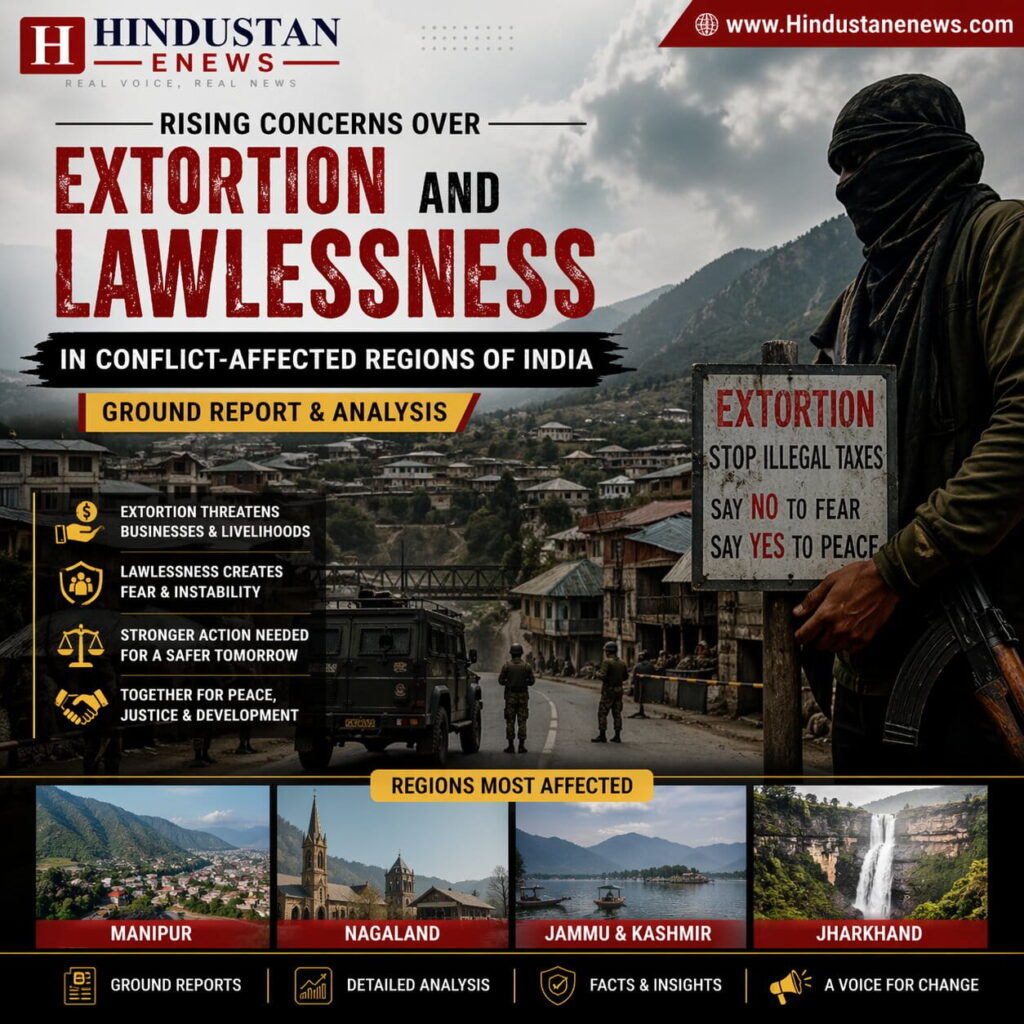





































Extortion and Lawlessness in Conflict Regions of India – Ground Report & Analysis

Rising Concerns Over Extortion and Lawlessness in Conflict-Affected Regions of India
Explore rising Extortion and Lawlessness cases in Manipur, Nagaland, Jammu & Kashmir, and Jharkhand. In-depth analysis, impact on citizens, government response, and solutions.
By Hindustan eNews Desk
Introduction
India’s conflict-affected regions are witnessing a worrying rise in extortion, coercion, and informal taxation systems that are disrupting livelihoods and weakening trust in governance. Areas such as Manipur, Nagaland, Jharkhand, and Jammu and Kashmir are increasingly under scrutiny as citizens and businesses report growing financial pressure from unlawful demands.
This ground-level reality reflects a deeper systemic challenge involving security, governance, and socio-economic imbalance. The situation is not only affecting businesses but also threatening the social fabric of these regions.
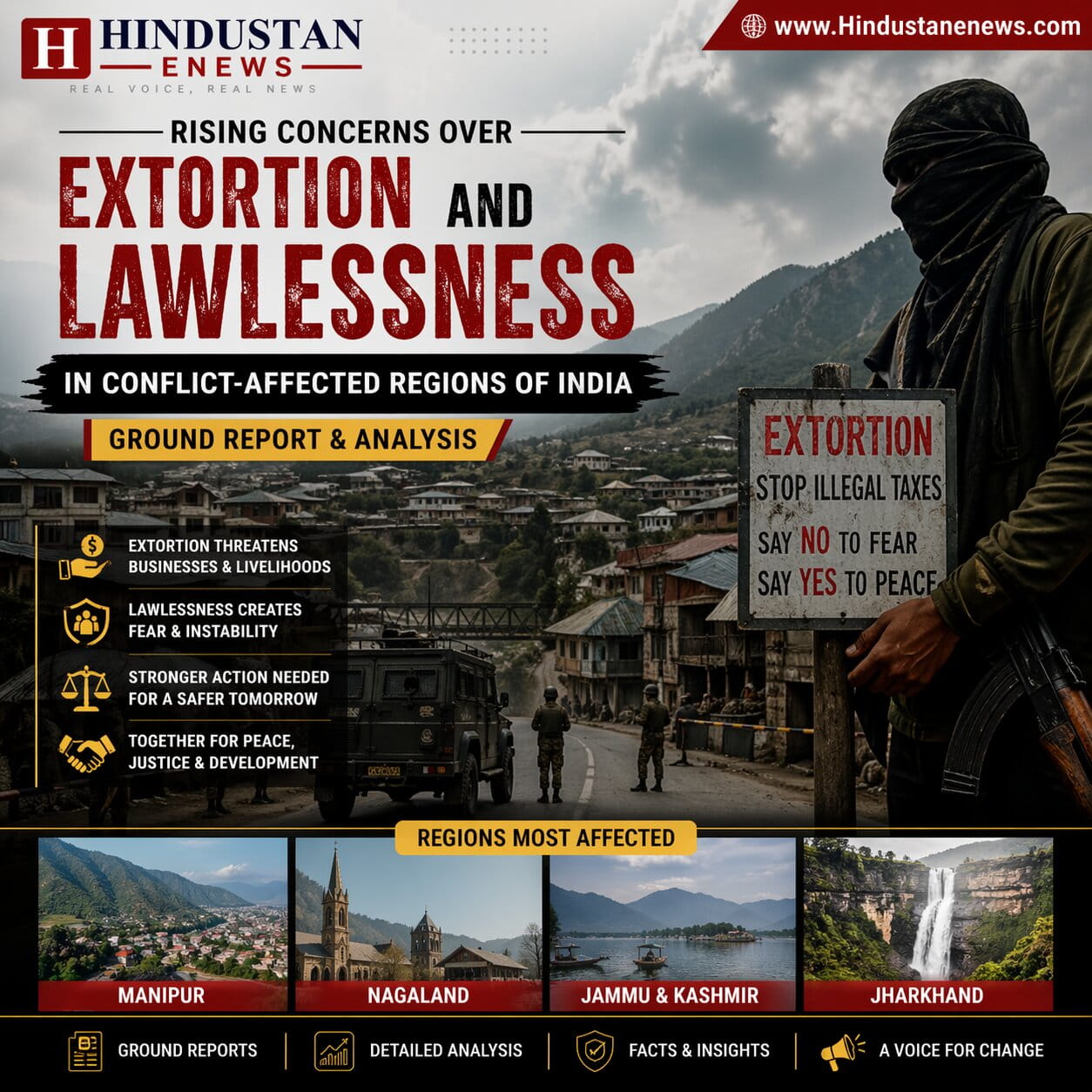
Table of Contents
| Section | Topic |
|---|---|
| 1 | Overview of the Crisis |
| 2 | Regions Most Affected |
| 3 | Impact on Businesses |
| 4 | Effect on Daily Wage Workers |
| 5 | Historical Context |
| 6 | Comparison with Global Examples |
| 7 | Economic Consequences |
| 8 | Governance and Accountability Issues |
| 9 | Government Response |
| 10 | Policy Recommendations |
| 11 | Future Outlook |
| 12 | FAQs |
1. Overview of the Crisis
In multiple regions across India, extortion is reportedly becoming a parallel system of economic control. These demands are often disguised as “donations,” “taxes,” or “protection fees.”
Citizens describe a growing climate where refusal to comply leads to:
- Business disruptions
- Threats and intimidation
- Restricted mobility of goods
- Loss of contracts
This has resulted in a shadow economy operating alongside formal systems.
2. Regions Most Affected
North-East India
States like Manipur and Nagaland have long faced insurgency-related challenges. However, recent reports indicate an increase in economic coercion affecting:
- Retail traders
- Transport operators
- Government contractors
Northern Region
In Jammu and Kashmir, despite improved security metrics, localized reports suggest continued pressure on businesses in certain pockets.
Central-Eastern Belt
Naxal-affected districts of Jharkhand are also experiencing extortion demands impacting mining, construction, and transport sectors.
3. Impact on Businesses
Small Enterprises Under Pressure
Small and medium enterprises (SMEs) are among the worst affected. Many business owners report:
- Reduced profit margins
- Increased operational risk
- Frequent disruptions
Some have even shut down due to sustained pressure.
Transport and Logistics
Transporters face dual challenges:
- Illegal levies at multiple points
- Delays due to threats or blockades
This increases costs across the supply chain.
4. Effect on Daily Wage Workers
The impact extends beyond businesses. Daily wage earners, contractors, and informal workers face:
- Reduced take-home income
- Forced contributions
- Limited job opportunities
This deepens poverty cycles in already vulnerable regions.
5. Historical Context
India has faced similar challenges in the past, especially in insurgency-hit areas. However, the current situation reflects a more structured and widespread system of informal taxation.
Historically, such systems emerge when:
- Governance gaps exist
- Security presence is limited
- Economic opportunities are scarce

6. Comparison with Global Examples
A frequently cited international example is Kowloon Walled City, which operated outside formal legal systems before its demolition.
Characteristics included:
- Parallel authority structures
- Weak law enforcement presence
- Informal economic systems
Experts warn that similar patterns, if unchecked, can erode institutional control.
7. Economic Consequences
Short-Term Impact
- Reduced business confidence
- Supply chain disruptions
- Increased cost of goods
Long-Term Risks
- Decline in investment
- Migration of businesses
- Slower regional development
According to policy experts, sustained extortion can deter both domestic and foreign investment.
8. Governance and Accountability Issues
A major concern among citizens is the lack of accountability.
Key Issues
- Citizens already pay taxes to the government
- Illegal levies create double financial burden
- Limited reporting due to fear of retaliation
This raises critical questions about:
- Effectiveness of law enforcement
- Protection mechanisms for whistleblowers
9. Government Response
Authorities have taken several steps, including:
- Increased security deployment
- Intelligence coordination
- Crackdowns on unlawful groups
However, challenges remain due to:
- Difficult terrain
- Complex socio-political dynamics
- Limited administrative reach in remote areas
For official updates and governance measures, refer to:
https://www.mha.gov.in (Ministry of Home Affairs – High DA Authority)
10. Policy Recommendations
Experts suggest a multi-pronged strategy:
Strengthening Law Enforcement
- Enhanced surveillance
- Faster legal action
- Local intelligence networks
Economic Development
- Job creation programs
- Infrastructure investment
- Support for small businesses
Community Engagement
- Awareness campaigns
- Protection for informants
- Collaboration with local leaders
Digital Monitoring
- Tracking financial flows
- Reducing cash-based transactions
11. Future Outlook
The path forward requires sustained effort from both government and civil society.
Key Priorities
- Restoring public confidence
- Ensuring safety of businesses
- Strengthening rule of law
If addressed effectively, these regions have strong potential for economic growth and stability.

Visit: Hindustan Enews
Official site: https://www.hindustanenews.com
FAQs & People Also Ask (PAA) Extortion and Lawlessness in Conflict Regions of India
1. What is extortion in conflict-affected regions of India?
Extortion refers to illegal demands for money, goods, or services by coercion. In regions like Manipur and Nagaland, it often appears as “forced donations” or unofficial levies imposed on businesses and citizens.
2. Why is extortion increasing in some parts of India?
Extortion rises due to weak enforcement, insurgency, limited economic opportunities, and difficult terrain, especially in areas like Jammu and Kashmir and Jharkhand.
3. Which regions in India are most affected by extortion?
The most affected areas include:
- Manipur
- Nagaland
- Jammu and Kashmir
- Jharkhand
4. How does extortion affect small businesses?
It reduces profit margins, increases operational risks, and sometimes forces closures due to continuous financial pressure.
5. What is meant by “parallel taxation”?
Parallel taxation refers to illegal collection of money by non-state actors, functioning like an unofficial tax system outside government control.
6. How does extortion impact daily wage workers?
Daily wage workers face reduced earnings as they are forced to pay a portion of their income, worsening poverty conditions.
7. Why do victims not report extortion cases?
Fear of retaliation, lack of trust in protection systems, and remote locations discourage reporting.
8. What industries are most affected by extortion in India?
Transport, mining, construction, and small retail businesses are the most impacted sectors.
9. Is extortion linked to insurgency or militancy?
Yes, in many regions extortion is associated with insurgent groups seeking financial support for operations.
10. What steps has the government taken to control extortion?
Measures include increased security deployment, intelligence coordination, and stricter legal action through agencies like the Ministry of Home Affairs.
11. How does extortion affect economic growth in conflict regions?
Extortion significantly disrupts economic growth by increasing the cost of doing business and discouraging investment. Businesses operating in regions like Manipur and Jharkhand often face repeated illegal demands, which reduce profitability and limit expansion opportunities.
Over time, this creates a negative investment climate where new businesses hesitate to enter the market. Additionally, supply chain disruptions caused by extortion-related threats lead to increased prices of goods and services. This ultimately slows down regional economic development and widens inequality compared to more stable parts of India.
12. What are the long-term consequences of unchecked lawlessness?
Unchecked lawlessness can weaken institutions, reduce public trust, and create an environment where illegal systems replace formal governance. Historical examples like Kowloon Walled City demonstrate how areas without effective law enforcement can develop into zones of uncontrolled activity.
In India, if such trends continue in regions like Jammu and Kashmir, it could result in reduced investor confidence, migration of skilled workers, and long-term socio-economic instability. Strong governance and consistent enforcement are essential to prevent such outcomes.
13. How can the government effectively tackle extortion in these regions?
A multi-layered approach is required to combat extortion effectively. First, strengthening law enforcement through better training, modern technology, and local intelligence networks is critical. Second, economic development initiatives such as job creation, infrastructure improvement, and financial inclusion can reduce dependency on illegal systems.
In areas like Nagaland, community engagement is equally important. Encouraging local participation in governance and providing safe channels for reporting crimes can help authorities act more effectively. Long-term success depends on balancing security measures with socio-economic development.
14. What role does technology play in reducing extortion activities?
Technology can play a transformative role in reducing extortion. Digital payment systems reduce reliance on cash, making it harder for illegal collections to go unnoticed. Surveillance tools, data analytics, and financial tracking systems can help authorities identify suspicious transactions.
In conflict-prone areas such as Jharkhand, implementing digital governance platforms can improve transparency and accountability. Additionally, mobile-based reporting systems can allow citizens to report incidents anonymously, increasing participation and reducing fear of retaliation.
15. How can citizens and businesses protect themselves from extortion?
Citizens and businesses can adopt several measures to protect themselves. Maintaining proper documentation, avoiding cash transactions, and reporting incidents through official channels are important steps. Businesses should also collaborate with local trade associations for collective security and representation.
In sensitive regions like Manipur, awareness programs and legal support systems can empower individuals to resist illegal demands. Ultimately, strong cooperation between citizens, businesses, and authorities is essential to create a safer and more secure environment.
16. Why is extortion considered a threat to national security?
Extortion is not just an economic issue but also a national security concern. Funds collected illegally are often used to support insurgent or criminal activities, which can destabilize entire regions.
In areas like Jammu and Kashmir, such activities can indirectly fuel unrest and hinder peace-building efforts. Therefore, controlling extortion is crucial for maintaining both economic stability and national security.
17. How does extortion impact investment in India?
Investors seek stable and predictable environments. Persistent extortion creates uncertainty, increases operational risks, and raises costs.
Regions affected by such activities, including Nagaland, may experience reduced domestic and foreign investment, slowing down economic progress and job creation.
18. What legal provisions exist in India to combat extortion?
Indian law addresses extortion under the Indian Penal Code (IPC), with strict penalties for coercion and unlawful demands. Law enforcement agencies are empowered to take action against such activities.
However, effective implementation remains a challenge in remote and conflict-prone areas like Jharkhand, where accessibility and security constraints exist.
19. How does extortion affect social stability in affected regions?
Extortion creates fear, mistrust, and inequality within communities. When people are forced to pay illegal dues, it erodes confidence in governance and increases social tension.
In regions like Manipur, this can lead to reduced community cooperation and hinder development initiatives.
20. What is the future outlook for conflict-affected regions in India?
The future depends on sustained efforts by the government, local communities, and stakeholders. With improved law enforcement, economic development, and technological integration, there is potential for significant improvement.
Regions such as Jammu and Kashmir have already shown progress in certain sectors, indicating that long-term stability is achievable with consistent policy implementation.
12. Conclusion
The rise in extortion and lawlessness in conflict-affected regions of India is a serious concern that demands immediate attention. While authorities have initiated steps, the complexity of the issue requires long-term, coordinated action.
Citizens in Manipur, Nagaland, Jammu and Kashmir, and Jharkhand continue to hope for stronger governance, better protection, and a future free from coercive pressures.
For more verified news and updates, visit:
Official Website: https://www.hindustanenews.com